
Exploring Plinko Risk Selection Across Digital Platforms
The Plinko Risk Selection Across Digital Platforms Plinko game has gained tremendous popularity in the digital gaming landscape, attracting players with its unique mix of chance and strategy. As we delve deep into the workings of this engaging game, we must consider the various dimensions around risk selection, probabilities, and the implications of these factors across digital platforms. Understanding how players evaluate risks in games like Plinko can provide valuable insights into behavioral trends, game design, and the broader implications of risk-taking in digital environments.
Plinko, a game that originated from the classic television show « The Price Is Right, » has transformed into a digital phenomenon where players drop a disc down a pegged board, allowing it to bounce randomly and land in different slots, each assigned various payouts. At first glance, the game may seem purely luck-based. However, savvy players can develop strategies to increase their winning potential by carefully selecting where to drop their disc, which introduces critical elements of risk and decision-making that deserve exploration.
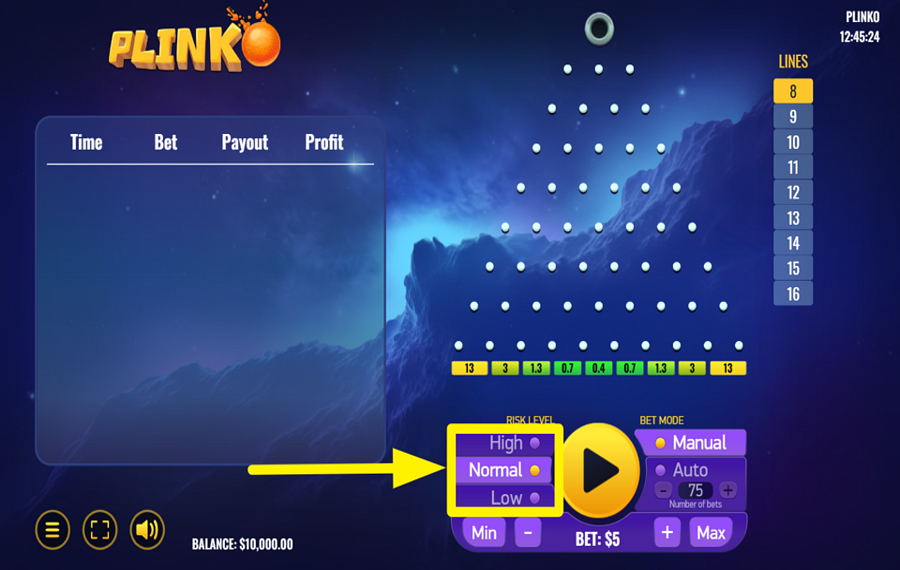
To understand the inherent risks in the Plinko game, it’s essential to break down the mechanics of gameplay. The game operates on a series of probabilities that determine where the disc might land. Players can choose their drop zones, often opting for positions that align with higher payouts while simultaneously assessing the associated risks. For instance, a player may prefer to drop the disc in a zone that generally yields higher returns but also has a lower probability of success, reflecting a willingness to embrace risk for potentially greater rewards.
The Psychology of Risk in Gaming
Human behavior in relation to risk is a well-studied phenomenon in behavioral economics and psychology. One theory that applies to the Plinko game is Prospect Theory, which posits that individuals perceive gains and losses differently. Players might focus more on the potential loss than the equivalent gain, leading to more conservative behaviors when making decisions about where to position their disc. This can create a paradox: players may know that a particular position could yield higher returns, yet their fear of loss prevents them from taking that leap.
Additionally, cognitive biases such as overconfidence can also play a significant role in how players select their risks. Many might believe they have a « lucky spot » where they consistently succeed, leading them to ignore statistical evidence. This self-perception can greatly influence decision-making processes, ultimately affecting the overall gaming experience and outcomes.

Strategic Approaches to Risk Selection
As players familiarize themselves with the Plinko game, they can develop various strategies for risk selection. Here are a few prevalent approaches:
- Risk-Averse Strategies: These players typically drop their discs in areas of the board that are statistically more likely to yield wins, even if the payouts are smaller. This cautious approach minimizes potential losses but can lead to slower accumulation of winnings.
- Risk-Tolerant Strategies: Risk-tolerant players are often willing to drop their discs in higher-risk areas for the chance of substantial payouts. This approach can be exhilarating but may also lead to significant losses if the player is not careful.
- Adaptive Strategies: More experienced players may adapt their strategies based on the results of previous rounds. They’ll monitor what has worked and what hasn’t, modifying their approach in real-time to account for evolving outcomes.
The Impact of Digital Platforms
Digital platforms have revolutionized how players engage with games like Plinko. The online format allows for instant access, diverse playing environments, and the integration of community features such as leaderboards and competitions. However, this also means that the traditional aspects of risk and reward have evolved into a much more complex web of variables.
For instance, the social aspect of digital platforms can influence risk-taking behaviors. When players observe others winning big, they may feel compelled to take more significant risks to compete. Conversely, seeing frequent losses in others may temper their enthusiasm to engage with high-risk strategies. The interconnectedness of players through forums, social media, and streaming platforms means that perceptions of success and strategies can ripple quickly through the community.

Probabilities and Mathematical Insights
Understanding the statistical underpinnings of the Plinko game enhances a player’s ability to make informed decisions about risk selection. While the game primarily relies on chance, players can examine probabilities help to strategize their gameplay.
For example, if a particular drop zone has a 25% chance of yielding a high payout but a 75% chance of dropping into a lower payout category, players weighing the odds would need to consider whether the potential for a larger gain outweighs the likelihood of a less favorable outcome. This type of calculation can significantly influence risk selection as players quantify their choices more methodically.
Additionally, the law of large numbers plays a role in risk assessment. As players engage in more rounds of the game, the randomness of each drop tends to average out; thus, individuals who play more often may find themselves adapting their strategies as they gain more insights into the probabilities at play.
The Future of Plinko and Risk Selection
Looking ahead, the future of the Plinko game and similar gaming formats will likely be shaped by technological advancements and data analytics. With the rise of machine learning algorithms and artificial intelligence, game developers can analyze player behaviors to enhance game design, potentially creating personalized gaming experiences that adapt to individual risk profiles.
Moreover, the rise of virtual reality (VR) and augmented reality (AR) may introduce entirely new dimensions to risk selection. Players could engage with the game more holistically, offering a tactile and immersive experience where risk assessment can combine with the physical world.
Conclusion
Plinko as a digital game presents a fascinating intersection of chance, strategy, and psychology. The evaluation of risk selection among players is not merely an academic exercise; it reveals much about human behavior in digital environments. As gaming continues to evolve with technology, understanding these dynamics will be critical for developers and players alike. Whether you’re a cautious player looking to secure modest wins or a daring high-roller chasing big payouts, the world of Plinko offers a rich tapestry of decisions that embodies the complexity of risk and reward.